George Mackay Brown
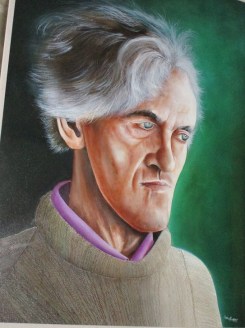
The Orkney Islands have produced and inspired many writers, poets, artists and musicians. Edwin Muir, Sylvia Wishart, Peter Maxwell Davis to name but a few.
Perhaps the writer most associated with Orkney is George Mackay Brown. A prolific author and poet. Born in 1921 in Sutherland, he spent his life in Stromness. His early career was influenced by other Orcadian writers, Muir, Ernest Marwick and Robert Rendall. His love for Stromness is clear in his essay collections Letters from Hamnavoe and Under Brinkie’s Brae.
We were surprised to see this letter from GMB to the writer, Ernest Marwick. It seems, that in 1946, GMB was living at 6 Well Park.
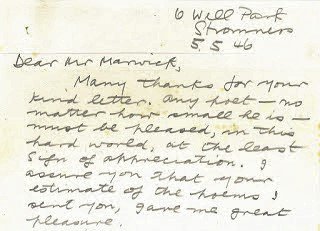
A modest man all his life, GMB finally retired to a small council house in Mayburn Court, opposite the Museum, where he died in 1996.
Dr John Rae

Of all the Orcadian travellers, adventurers and explorers, perhaps Dr John Rae is the most remarkable.
Rae was born in 1813 at the Hall of Clestrain, near Stromness. He studied medicine and went on to qualify as a surgeon. In this capacity he took a position with the Hudson’s Bay Company in Ontario. He served as a surgeon for some ten years and his work brought him into contact with the First Nation peoples of Canada. From them he learned techniques for survival and light travel in the Canadian arctic.
Rae trained as a surveyor with the HBC and, in 1844, travelled overland on the first of many expeditions to try and find the Northwest Passage, linking the Pacific and Atlantic Oceans. Rae was one of the first Europeans to spend winter in the high arctic without a supply ship.
On one such journey, through his contacts with the Inuit, Rae discovered the fate of the Franklin Expedition, which had disappeared ten years previously. Rae reported his findings to London but was dismissed and shunned for suggesting that Franklin’s men had resorted to cannibalism to survive.
It is believed that Rae identified the missing link in the Northwest Passage and the Rae Strait is named after him.
He died in London in 1893 at the age of 80 and was buried in St Magnus Cathedral in Kirkwall. He was never fully recognised, in his lifetime, for his achievements and in 2017 he was belatedly given the freedom of Stromness. A truly incredible man.
Stanley Cursiter
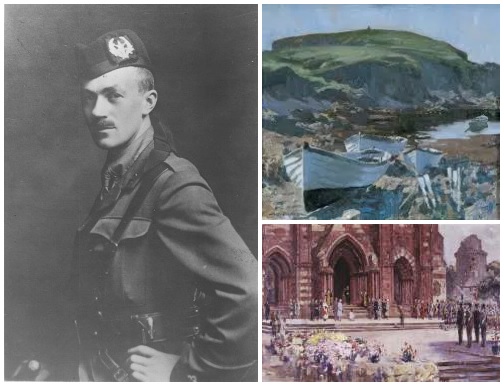
Stanley Cursiter was born in Kirkwall in 1887, prior to the First World War he studied at the Edinburgh College of Art. During the war he served as an officer with the 1st Battalion of the Cameronians. Conditions in the trenches caused ill health and he was withdrawn to a Field Ordnance Survey battalion. With his artist’s eye he developed techniques for analysing aerial photography.
Cursiter was associated with the Orcadian Woman’s Suffrage Society, having designed its banner and he married Phyllis Hourston, one of its members. The OWSS was subject of an exhibition in Stromness in 2018 and this little animation was included. The animation went on to win an award at the 2019 Scottish Short Film Festival.
After the war Cursiter’s art career flourished and, in 1930, he became the Keeper of the National Galleries of Scotland. In 1948 he was appointed as the King’s (later the Queen’s) Painter and Limner for Scotland. He held that position until his death in 1976.
Stanley Cursiter lived in the last house at the south end of Stromness, next to Well Park.
Robert Shaw
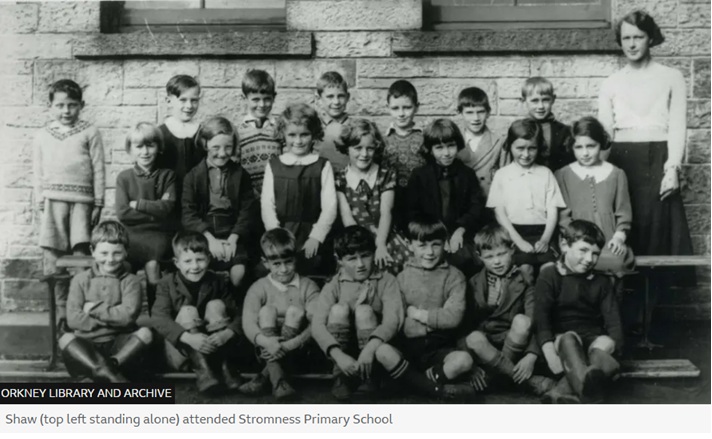
Robert Shaw was born in Lancashire in 1927 and lived there until the age of seven, when his father Thomas took over a GP practice in Stromness, Orkney’s second-largest town.
Famed for playing the hard-bitten, shark-hunting, salty sea dog from Steven Spielberg’s 1975 summer blockbuster Jaws, Shaw often recalled his time in Orkney and his father, “Those terrible islands where there’s wind and sea and you get a hundred-mile-an-hour gales.”
His father “…was an extraordinary man, a marvellous man and he was a doctor in the Orkney Islands, which is right at the top of Scotland. He was the lighthouse doctor and he used to keep a medical bag on each island and when you couldn’t get in because the sea was so rough, my father would go out… and jump off and swim ashore.”
His childhood wasn’t easy and his parents split up, after around six years in Stromness their mother left her husband and took the children south, to England.
His five years as a child in Orkney had a huge effect on the rest of his life.
Groundskeeper Willie
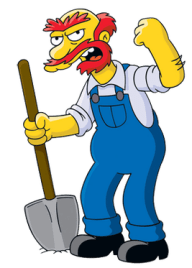
Known as the angriest Scot in the world, Groundskeeper Willie revealed that he isn’t from Edinburgh, Glasgow or Aberdeen but from Orkney! He was born into a broken home, in Kirkwall. Willie, the famously misanthropic janitor in The Simpsons, tells a bemused Bart Simpson that he grew up in a house divided, not by religion or politics, but by the famous Kirkwall Ba Game, a mass scrum that rolls through the royal burgh’s streets on New Year’s Day. Willie explains that his father was an “Uppie” and his mother a “Doonie”, and the split “tore my family apart”.
Someone on The Simpsons team has done their homework!

 Scapa Views
4 thoughts on “Local Heroes”